
Wholesale bags / VISUAL BUYER GUIDE
How to Measure a Handbag for an Online Listing
Measure the actual handbag body side to side, bottom to top and front to back, then record the handle or strap drop separately. Show where your ruler starts and ends, because sellers do not always use width and depth to mean the same thing. Use the diagrams and free template below to give customers useful measurements instead of asking them to guess from a photo.
Put this guide to work.
Download the free checklist or template, then follow the steps below. No email required.
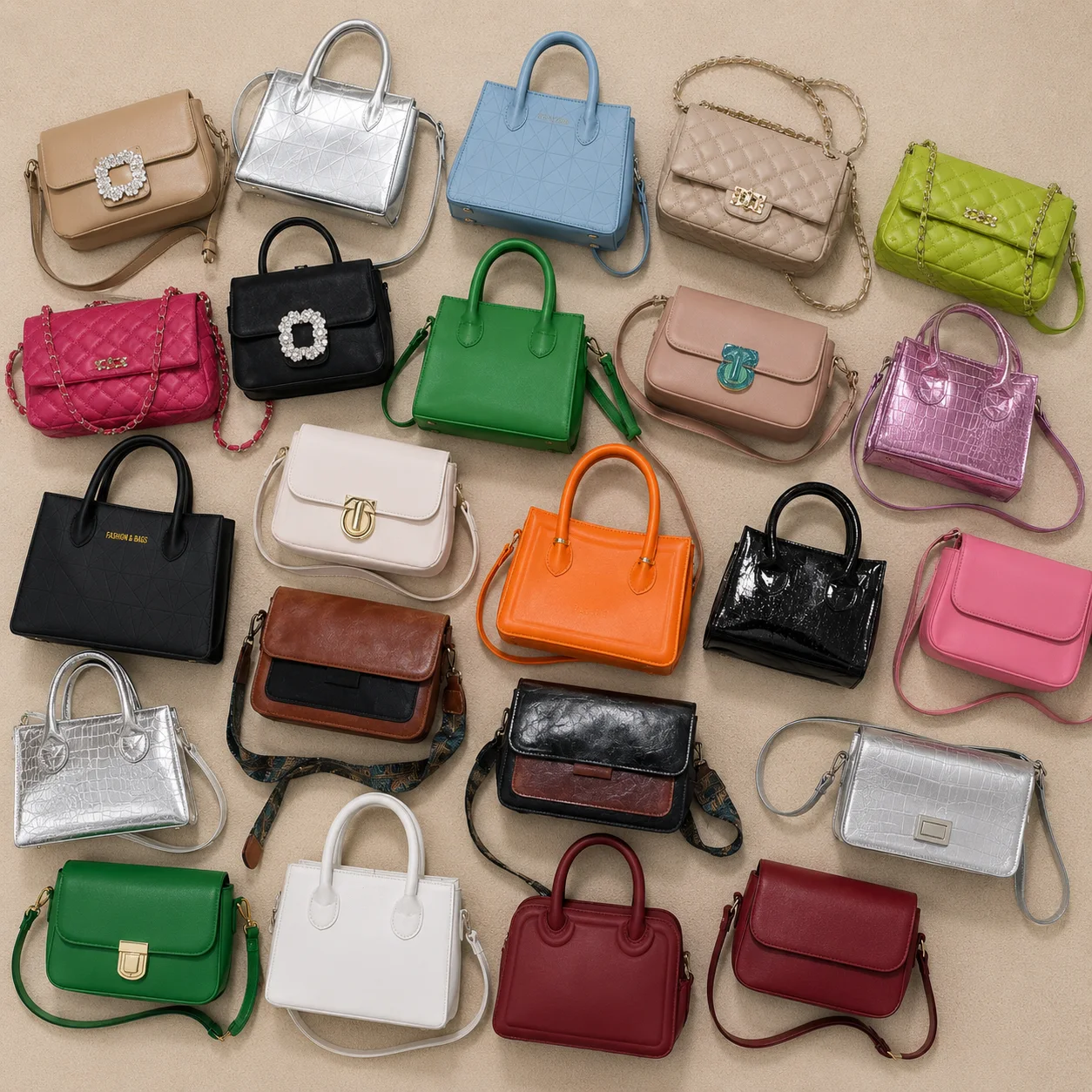
“Will it fit my notebook?” is a different question from “Does it look roomy?” A few clear measurements help answer the first one. Start with the actual item you plan to sell, label each direction and keep the units beside every number. Then check the opening and the inside if a particular object needs to fit. Outside dimensions alone do not establish usable space.
Measure the body in three directions
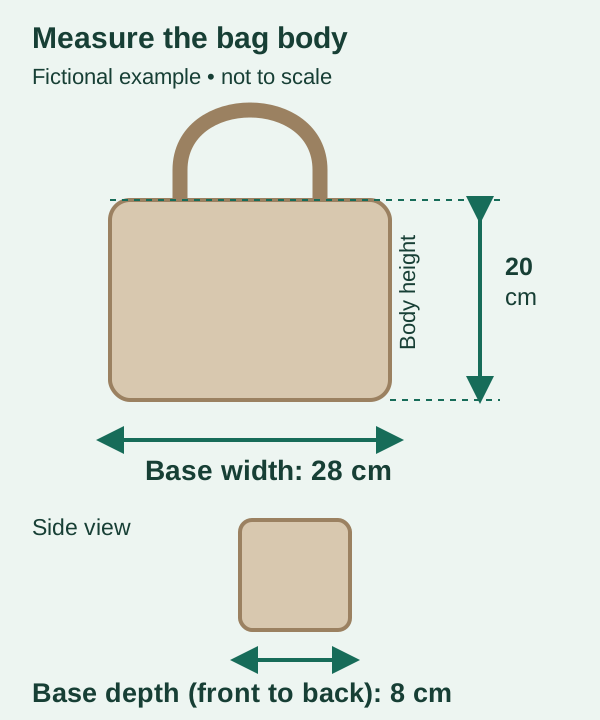
Front width: side to side
For this guide, front width means the horizontal distance across the front of the bag. Measure the base and, if it differs, the top opening or widest part. Name the point you used: “base width” is clearer than an unexplained number. Some retailers call this direction length instead.
Body height: leave the handles out
Measure vertically from the base to the top edge of the bag body. Keep handles and straps separate. On a curved or slouchy top, show the centre point you used and say whether the bag was standing naturally or laid flat. Do not pull a soft bag taller just to reach a bigger number.
Depth: front to back
View the bag from the side and measure its base from front to back. Keep the base open in its natural shape without stretching it. If the bag has an unusual shape, add a side photo with the ruler so your customer can see what that depth describes.
Naming conventions vary. Our template spells out front width, body height and base depth instead of relying on W × H × D alone.
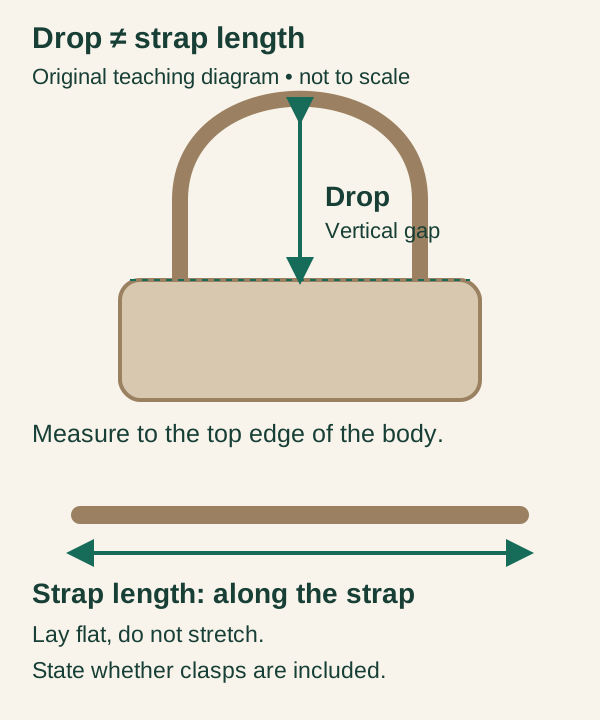
Separate handle drop from strap length
- 01
Handle or strap drop
Raise the handle or strap into its carrying position without stretching it. Measure the straight vertical gap from its highest inside point down to the top edge of the bag body. Identify the handle or strap measured and keep a photo of the two endpoints.
- 02
Strap length
If the strap can safely be removed, lay it flat without stretching and measure along it from end to end. State whether the figure includes clasps or only the strap itself. If you cannot remove it, explain your method rather than forcing or unfastening a part that is not designed to detach.
- 03
An adjustable strap
Record the shortest and longest usable settings, using the same method for both. Say whether your range describes strap length or vertical drop. Neither number guarantees where the bag will sit on every wearer; body shape, clothing and the bag itself affect fit.
A curved handle is longer along its curve than its vertical drop. Do not divide a strap length by two and label that result as a measured drop.
Use a repeatable setup for soft bags
- 01
Set it down naturally
Empty the bag, remove packing that changes its shape and let it rest on a flat surface. For a very soft style, record “laid flat, unstretched” if it will not stand. If gentle support is necessary to show its shape, describe that setup rather than hiding it.
- 02
Keep the ruler straight
Use a ruler for straight body dimensions and a flexible tape for a curved or laid-flat strap. Read from zero and avoid wrapping the tape around a rounded bag when you mean a straight side-to-side measurement. Repeat a reading if the bag moved.
- 03
Keep measurements with the item ID
Save the measurement photo under the same inventory code as the listing. Similar bags from a mixed lot can differ in shape, strap and size. Measure each distinct item you offer instead of copying one supplier example across the whole batch.
Convert centimetres to inches without false precision
- 01
Use the conversion once
One inch equals exactly 2.54 cm. Divide a measurement in centimetres by 2.54 to get inches; multiply inches by 2.54 for centimetres. Keep the original reading so you do not repeatedly convert a rounded result.
- 02
Try this fictional example
A bag body measured at 28 cm across the base, 20 cm high and 8 cm deep becomes approximately 11.0 in × 7.9 in × 3.1 in in that same order. These are teaching numbers, not measurements of the bags in the cover photo.
- 03
Match the detail to your method
A hand measurement of a flexible bag does not justify a long string of decimals. Label the measurements approximate and state your method. If your readings disagree, measure again; do not invent a universal tolerance or silently choose the larger result.
Copy a size block your customer can understand
Download the blank size template
Under Sources & further reading, download the text template and fill in the fields for your actual item: inventory ID, front width at base, top opening, body height, base depth, handle drop and strap length or drop range. It is a plain text file you can copy into your listing.
Explain the measurement conditions
For example: “Approximate external measurements, empty and standing naturally: base width 28 cm (11.0 in), body height 20 cm (7.9 in), base depth 8 cm (3.1 in). Handles excluded from body height.” This is fictional copy; replace the values with your own measurements.
Check a fit claim separately
Before saying a notebook, phone or laptop fits, check its actual dimensions against the opening and internal space, or try that exact object without forcing it. Allow for the closure, lining and internal compartments. An outside width does not prove that a rigid object will pass through a narrower opening.
Buyer questions
Is handbag width the same thing as depth?
Not consistently across sellers. Some retailers use length for the front measurement and width for front-to-back depth. In your own listing, label the directions in plain words and include a measurement photo so the numbers are unambiguous.
Should bag height include the handles?
Keep body height separate from handle or strap drop, and say so in the listing. If you also provide total height including a raised handle, label it as a separate measurement and show how it was taken.
Can I measure every bag from one assortment photo?
No. Perspective, unknown scale and different shapes prevent a reliable measurement of each item. Use the physical goods you actually receive or ask for item-specific measurements that clearly identify the bag and measuring points.
Does a handbag’s outside size prove a laptop will fit?
No. The opening, internal dimensions, padding and closure can reduce usable space. Check the specific device or an accurately sized object separately before making that claim.
Sources & further reading
Yumiao-specific details reflect our published service information. External references provide general background.
HOW YUMIAO CAN HELP
Put the guide to work.
Use the template after you receive the goods to prepare accurate individual listings. If you are considering a Yumiao wholesale order, ask what current representative photos and measurement information can be provided. Featured ranges are random mixed assortments with a 50-bag minimum; individual styles, colors and a uniform size mix cannot be selected or assumed.
Products, availability, minimum quantities and order arrangements are confirmed individually.