
Wholesale bags / VISUAL BUYER GUIDE
A 30-Day Sales Review for Your First Mixed Handbag Lot
Review a mixed handbag lot by tracking each item from its first listing date, recording sales and returns separately, and checking what was actually available to buy. Use 30 days as a review window, not a sell-out deadline. The worksheet and two fictional examples below help you decide what to keep showing, explain better or investigate before buying again.
Put this guide to work.
Download the free checklist or template, then follow the steps below. No email required.

A box of mixed bags is not one product with one sales story. Some items may have been visible for a month; others may still be waiting for a photo. Start with three questions: what was listed, what sold, and what remains sellable? These are records of your own retail test, not proof that the next random lot will contain the same items.
1. Start the clock when the item is actually listed
Choose a review window
Write the start and end dates and the sales channels included. Keep the lot ID and a separate item ID for each style or individual bag. Mark the first listing date, pauses and sold-out periods rather than assuming every item had 30 days of exposure.
Use clear stock states
Separate listed-and-sellable items, unlisted but sellable items, reserved units and goods on hold for inspection. A bag waiting for photos is not evidence that shoppers rejected it. A held or reserved bag is not freely available to another buyer.
Record completed unit sales
Keep units sold, returns and cancellations distinct. An unpaid inquiry, saved Pin, page view or WhatsApp click does not count as a completed sale. Apply one documented sale/fulfillment rule consistently across the window.
2. Reconcile the physical count before judging performance
- 01
Count movements, not listing changes
Closing physical units = opening physical units + received units + returned units - units sold and removed - other outgoing units. Record the date and reason for write-offs or transfers. Listing an existing bag is a status change, not a new receipt.
- 02
Example A: account for returns
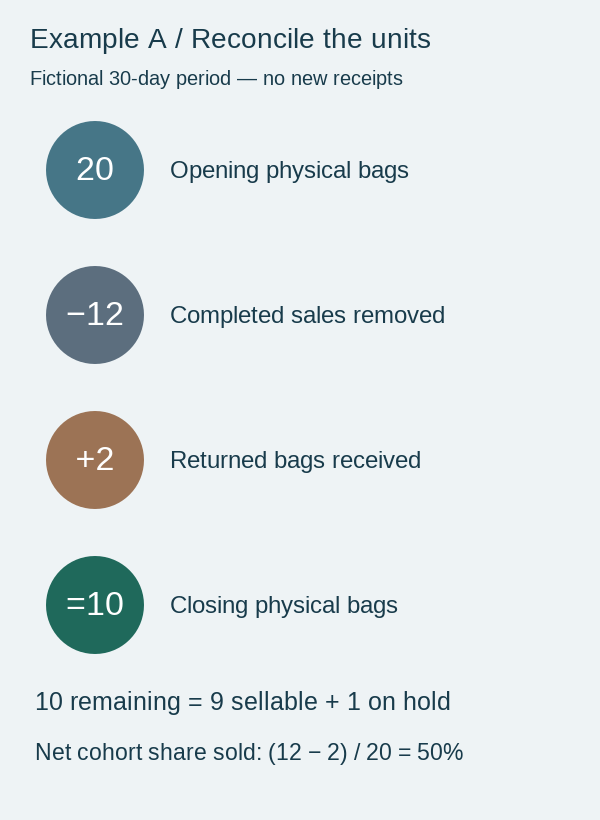
Fictional example: 20 bags at the start, no new receipts, 12 sales removed from stock and 2 of those bags returned during the window. Closing stock is 20 - 12 + 2 = 10. After inspection, suppose 9 are sellable and 1 is on hold. Count 10 physical units, not 9.
- 03
Keep the result label precise
In this fixed-cohort example, net units sold are 12 - 2 = 10. Net share of the original lot sold is 10 / 20 = 50%. This is our simple cohort measure, not a claim that every platform uses this sell-through definition. Older-order returns, new receipts or losses need separate treatment.
Shopify inventory reports distinguish inventory states and define their own metrics. Read the exact report definition and date window before comparing it with this worksheet. There is no universal success percentage in this guide.
3. Do not compare listed stock with unopened stock
- 01
Example B: 4 sales from 20 received
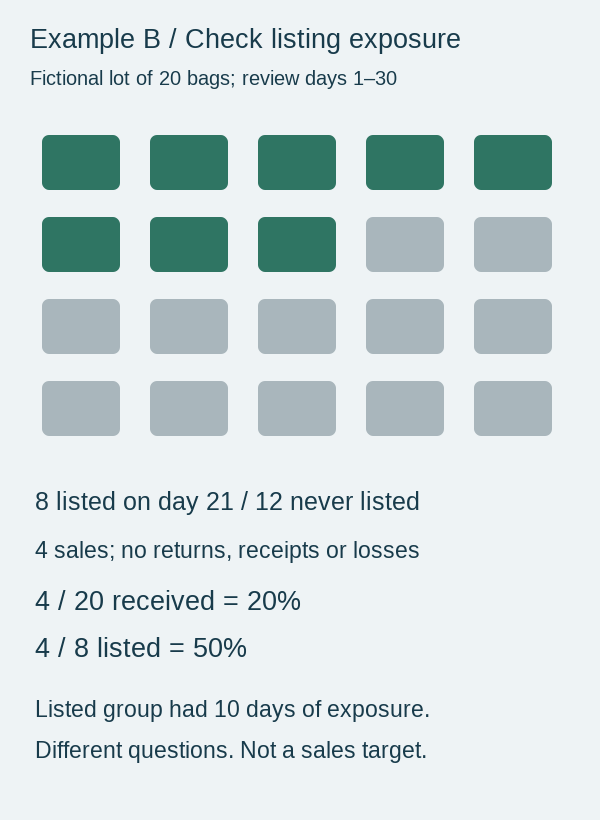
Fictional example: 20 bags received, but only 8 were listed, starting on day 21. The other 12 were never offered during the review. With 4 completed sales and no returns or additions, 16 physical bags remain: 4 listed and 12 unlisted.
- 02
The same four sales, two denominators
Four out of the original 20 is 20% of the received cohort. Four out of the 8 listed is 50% of the listed group. Both calculations are correct for different questions; neither proves the unlisted 12 are unpopular.
- 03
Exposure still differs
Those 8 bags had only 10 days listed in a 30-day review. Do not compare their 50% directly with a group available for all 30 days and call one better. Note the listing dates, audience, channel, promotions and any stockouts first.
Examples A and B are invented illustrations, not sales targets, customer case studies or recommended purchase quantities.
4. Record the question, then choose one useful fix
Keep showing when the information is clear
If an item is accurately described, available and receiving relevant interest, continue observing. A small sample can take time. Record actual outcomes instead of treating a single sale as a trend.
Rewrite when buyers cannot understand the item
If people repeatedly ask about size, compartments or the closure, add verified measurements and plain descriptions. Log the anonymous question and the change date; do not store the customer name, phone number or message transcript in this worksheet.
Retake photos when details are hard to see
If buyers cannot identify the item or see the requested detail, photograph the actual bag again. Keep its item ID attached to the new photo. Do not invent a material, capacity or brand to make the listing more attractive.
Pause when you cannot fulfill or explain the offer
Keep unclear-condition items on hold. Investigate count differences before accepting orders. If too much stock is still unlisted or your costs are unclear, pause another purchase while you resolve those gaps; this is a review question, not a fixed reorder formula.
5. Use the 30-day sheet and write a short decision note
- 01
Fill the daily movement rows
Download the blank CSV and duplicate a day row for each item ID you track. Enter opening stock, receipts, completed unit sales, returns, other outgoing units and closing physical stock. Then record listed/sellable, unlisted, reserved and held quantities without double-counting them.
- 02
Summarize what changed
At the end, write the gross sales, returns, net sales under your rule, closing stock and item exposure dates. Add one anonymous recurring question and what you changed. Missing records should say unknown, not zero.
- 03
Choose the next observation
Example decision note: "These items were listed late. Finish their photos, correct the measurement fields, then review another comparable period before deciding on more stock." Set a review date rather than promising that everything will sell by day 30.
Turn this guide into a buying plan.
Compare a 50-bag base budget and prepare the questions for your quotation.
Use the wholesale bag budget planner ↗An estimate does not confirm availability or the complete order total.
Buyer questions
Does 30 days mean I should sell every bag within a month?
No. It is a practical review interval in this guide, not a sell-out promise or an industry target. Listing dates, demand, price, channel and availability can differ.
Should I compare revenue or units?
Keep both if available, but do not substitute one for the other. This worksheet focuses on units and stock status. Revenue is not profit; costs and returns need separate records before you judge financial performance.
Can I reorder the exact style that sold well?
Do not assume so with a random mixed lot. Yumiao featured ranges start at 50 bags and individual styles and colors cannot be selected. Use your review to assess whether the mixed model fits your business, then confirm current information before ordering.
Sources & further reading
Yumiao-specific details reflect our published service information. External references provide general background.
HOW YUMIAO CAN HELP
Put the guide to work.
Use your own reviewed sales and stock records to decide whether another random mixed purchase suits your business. Yumiao featured wholesale bag ranges have a 50-bag minimum; individual styles and colors cannot be selected. Ask for current representative information after you have checked your actual needs, rather than expecting the next lot to repeat a successful item.
Products, availability, minimum quantities and order arrangements are confirmed individually.