
Wholesale bags / VISUAL BUYER GUIDE
Small Handbag Display Ideas for Pop-Up Shops and Market Stalls
Start with the bags you have actually received and checked, choose one grouping rule, and leave a clear place to lift and compare an item. Put an item ID and clear selling price with each bag, then keep checkout and spare stock out of the browsing area. Try the two fictional 12-bag layouts below before setting up your own space.
Put this guide to work.
Download the free checklist or template, then follow the steps below. No email required.
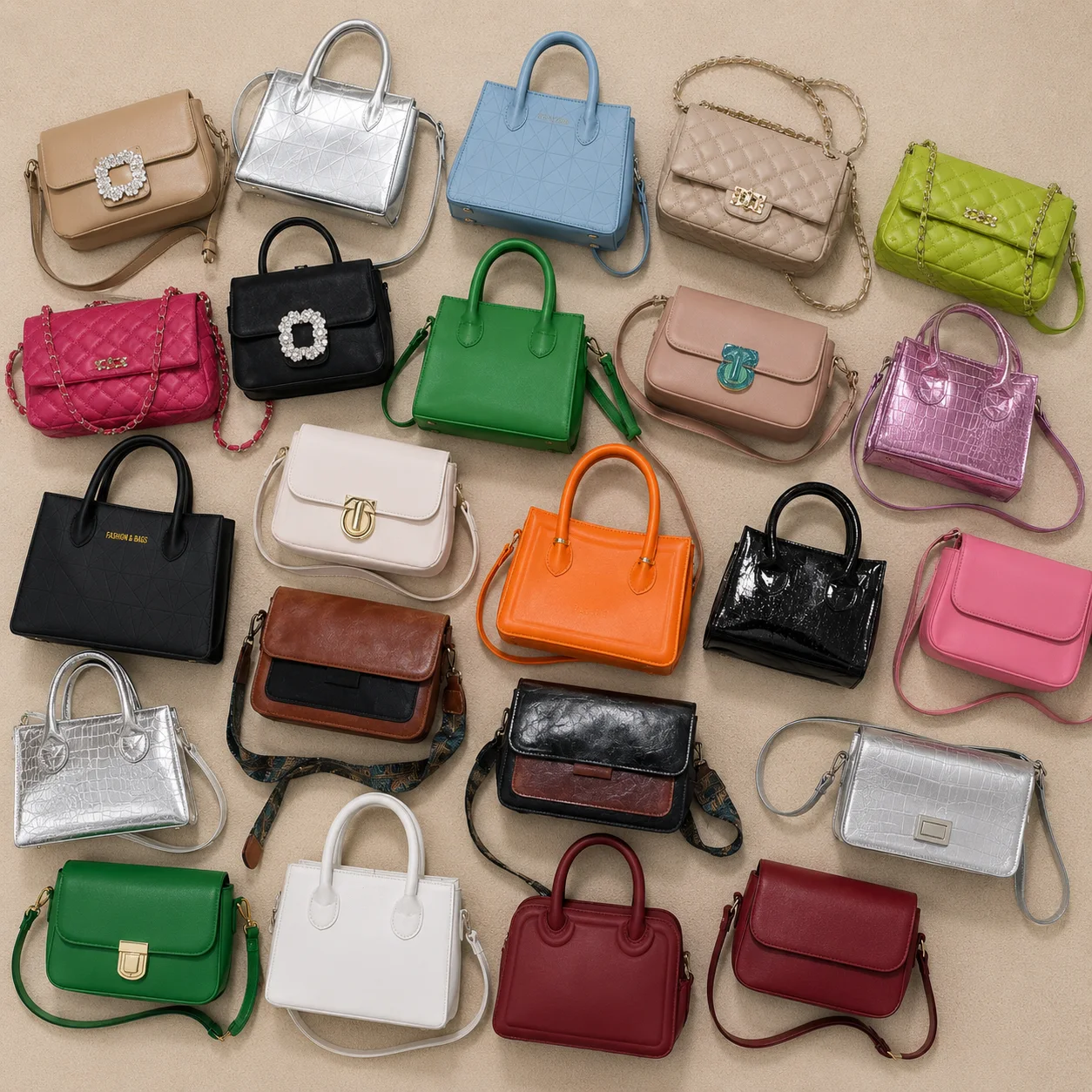
A table full of bags can be exciting until a customer has to untangle three straps to pick one up. Give each item a readable place and a simple reason for being there. Begin with fewer visible pieces if the actual footprints overlap. Your goal is to make it easy to see a bag, find its price and put it back without disturbing its neighbours.
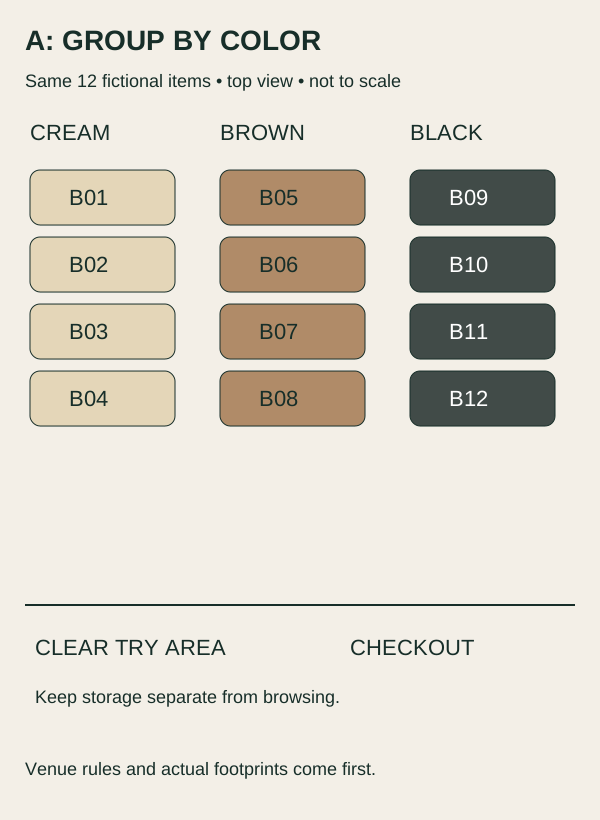
Try layout A: group the same 12 bags by color
- 01
Start with an honest stock list
Our fictional example uses IDs B01–B12: four cream, four brown and four black bags. Each color contains two totes, one shoulder shape and one compact bag. These are invented teaching records, not a Yumiao mix or a promise about what arrives.
- 02
Make three easy-to-read groups
Put B01–B04 in the cream group, B05–B08 in brown and B09–B12 in black. Face each bag so its opening and handle are visible. Keep straps with their own item; do not let them cross price labels or pull on the next bag.
- 03
Leave a try area
Reserve an empty spot where a customer can set down one bag and check its opening or strap with your help. The diagram is not to scale. Use actual bag footprints and venue requirements to decide how many pieces fit; 12 is an example, not a capacity recommendation.
Color names describe an observed grouping, not a material or brand. If your received stock has a different balance, group what is actually present instead of copying the diagram.
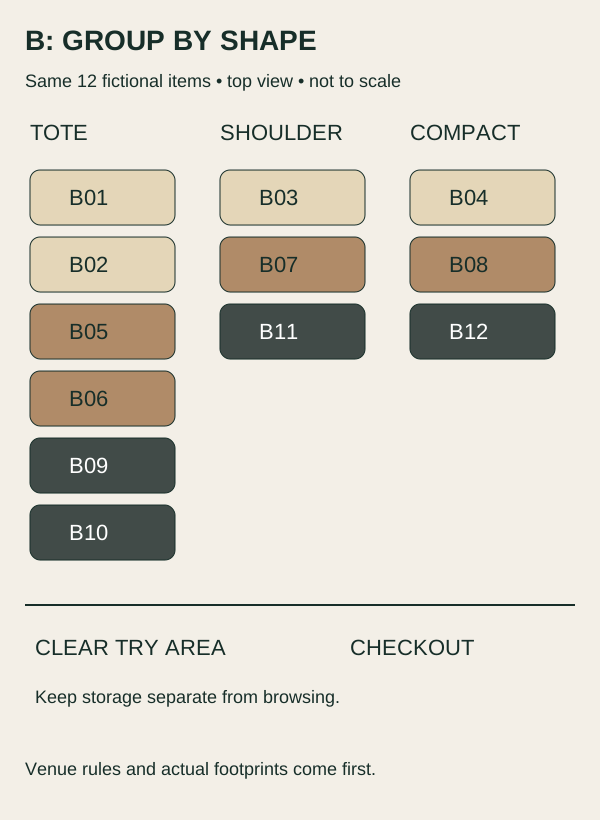
Try layout B: group by the way the bag is carried
- 01
Tote shapes
Move B01, B02, B05, B06, B09 and B10 into the tote group. These six fictional items share a broad shape category, not identical dimensions or capacity. Keep each item’s own tag and measured information.
- 02
Shoulder shapes
Group B03, B07 and B11. Let customers see the carrying shape, but check the actual strap and fit rather than promising that every bag sits the same way on every wearer. Do not advertise adjustable or detachable straps unless checked.
- 03
Compact shapes
Group B04, B08 and B12. Small does not prove phone fit. Keep checked dimensions available and help the customer compare the opening with the object they need to carry.
Both layouts use exactly the same IDs. Change the grouping, not the stock facts. Keep a photo of each arrangement if you want to remember how it was set up.
Give the label one clear job
Keep the price with the right item
Use a consistent, readable label showing the item ID and your actual selling price in the applicable currency. State the offer clearly under your local selling requirements. Do not copy wholesale range prices onto individual retail items without your own pricing decision.
Make the ID useful behind the table
Match the label to your inventory row and actual-item photo. A removable tag or individual holder can help; test attachments so they do not mark the bag. Put shelf or box location in a separate field instead of renaming the item when it moves.
Answer detail questions nearby
Keep dimensions, condition notes and included parts available for that exact item. A simple label can stay short while a separate item record carries the details. Do not add unverified leather, waterproof, brand or durability claims to make the display sound more impressive.
Keep browsing, trying and checkout from colliding
Check the real venue
Follow the organiser’s current rules for access, exits, fixture stability and stall boundaries. Our drawings are merchandising sketches, not accessibility, fire-safety or engineering plans. Do not use them as a substitute for the venue’s requirements.
Test the setup with actual bags
Lift one bag, open it, return it and read its label from the customer side. If a strap catches, a stand rocks or a label disappears, adjust the setup before opening. Use fixtures suitable for the actual load; avoid a tall stack just to show every piece.
Separate checkout and storage
Keep your payment station and packing work where you can supervise them without blocking the try area. Store spare stock securely in a separate labelled location. No loose packing, cords or open boxes should create obstacles in the browsing space.
Open with a checklist, then learn one thing
- 01
Use the free opening worksheet
Download the checklist above. Record the layout, displayed IDs, spare-stock location, price-label check and a lift-and-return test. Reconcile display pieces with the available inventory count before opening.
- 02
Update when an item sells
Remove or update its tag and available quantity promptly, including other channels where that same physical item is offered. Replace the empty space only with an item you have actually checked and labelled. A spreadsheet does not synchronise listings automatically.
- 03
Record questions without identifying people
Write a short anonymous note such as “asked where the small bags were” or “could not find the price.” Try changing one grouping or label placement next time. A busy stall or more handling does not by itself prove more sales, and a different day is not a controlled experiment.
Turn this guide into a buying plan.
Compare a 50-bag base budget and prepare the questions for your quotation.
Use the wholesale bag budget planner ↗An estimate does not confirm availability or the complete order total.
Buyer questions
How many bags should I put on a small stall?
Use the actual bag footprints, fixture capacity and venue requirements. Our 12-item drawings are fictional examples. Start with fewer pieces if customers cannot lift one without disturbing the rest.
Should I group handbags by color or style?
Either can work as a starting hypothesis. Color makes a palette easy to scan; shape helps someone find a carrying type. Try one rule at a time and note where customers still need help.
Can I order the exact assortment in these drawings?
No. Yumiao’s featured wholesale ranges are random mixes with a 50-bag minimum; individual styles and colors cannot be selected. Plan displays from received and checked goods.
Sources & further reading
Yumiao-specific details reflect our published service information. External references provide general background.
HOW YUMIAO CAN HELP
Put the guide to work.
Use the worksheet with your actual stock before the next market day. If you are considering a Yumiao order, review the random assortment rules first and ask for current representative photos. A teaching layout is not an allocation promise.
Products, availability, minimum quantities and order arrangements are confirmed individually.